

close
Choose Your Site
Global
Social Media


Views: 100 Author: Mok Publish Time: 2025-08-28 Origin: Site


I. Introduction
Between the domes and walls of church architecture, mosaics, like bright stars, carry religious beliefs, historical heritage, and artistic ingenuity. They tell sacred stories in an eternal manner and become a visual bridge connecting the earthly world and the heavenly kingdom.
Special Note: The content of this article is generated by AI. It is only a sorting and sharing of knowledge related to art and culture. It does not represent the position of any religious institution or organization, nor does it involve the authoritative interpretation of specific religious doctrines. It aims to introduce church mosaics from the perspective of art and culture for communication and discussion among those interested.
II. Artistic Origin and Cultural Foundation
(I) Historical Context
The art of mosaics can be traced back to the ancient Egyptian and Mesopotamian civilizations, and reached its peak in church architecture during the Byzantine period. Small pieces of colored glass, marble, or ceramics are inlaid to form pictures. With the light of the church, they refract a mysterious and solemn religious atmosphere, allowing believers to feel the power of faith in the changing light and shadow.
(II) Religious Significance
As the core carrier of religious art, church mosaics mainly take Bible stories, the lives of saints, and religious symbols as themes. From the birth, passion, to resurrection of Jesus, from the holy deeds of the Virgin Mary to the martyrdom of saints, each piece is a vivid interpretation of religious teachings. It helps illiterate believers understand their faith and strengthens the connection of religious emotions.
III. Craftsmanship: Devotion and Excellence in Details
(I) Material Selection
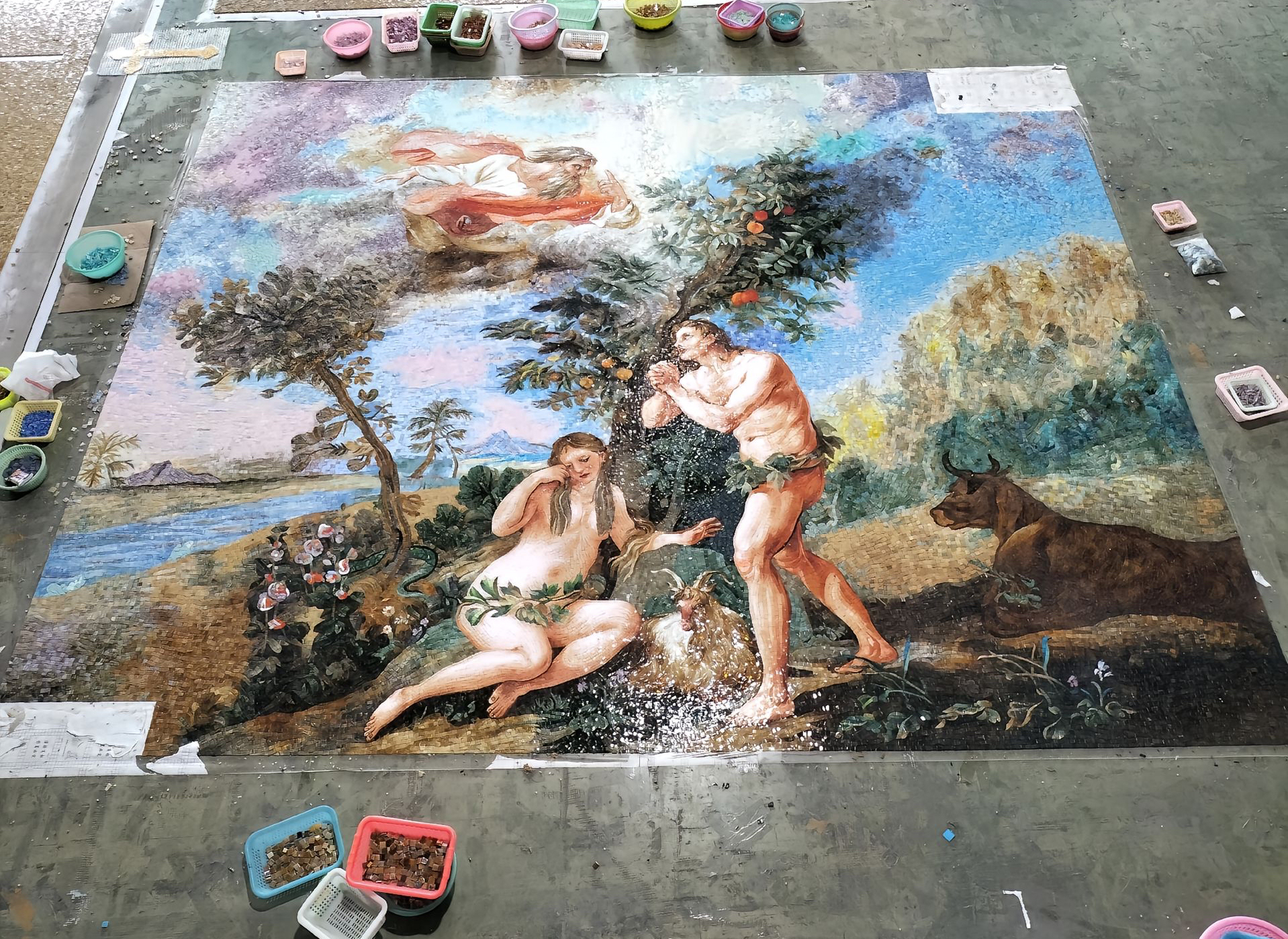
Craftsmen carefully select glass mosaics (rich colors are presented by adding metal oxides, and gold leaf glass adds more sacred radiance), and natural stones (the unique texture of marble endows the picture with a simple and heavy feeling). Each material is cut into tiny inlays and becomes the “pixels” for constructing the sacred picture.
(II) Creation Process
Design Drafting: First, based on religious classics, draw accurate sketches on the plane, determine the composition, character layout, and color levels. This is the foundation for controlling the final effect.
Inlay Construction: According to the design, position the inlays one by one and fix them with mortar, paying attention to color transition and light and shadow creation. For example, to show the folds of the saint's clothes, arrange light and dark inlays to simulate the texture of the cloth and the projection of light, making the picture vivid and three-dimensional.
Detail Polishing: After completing the initial inlay, finely adjust the gaps between the inlays and polish the surface to ensure the overall visual harmony, so that every detail conveys devout ingenuity.
IV. Appreciation of Classic Cases
(I) Masterpieces of Byzantine Churches
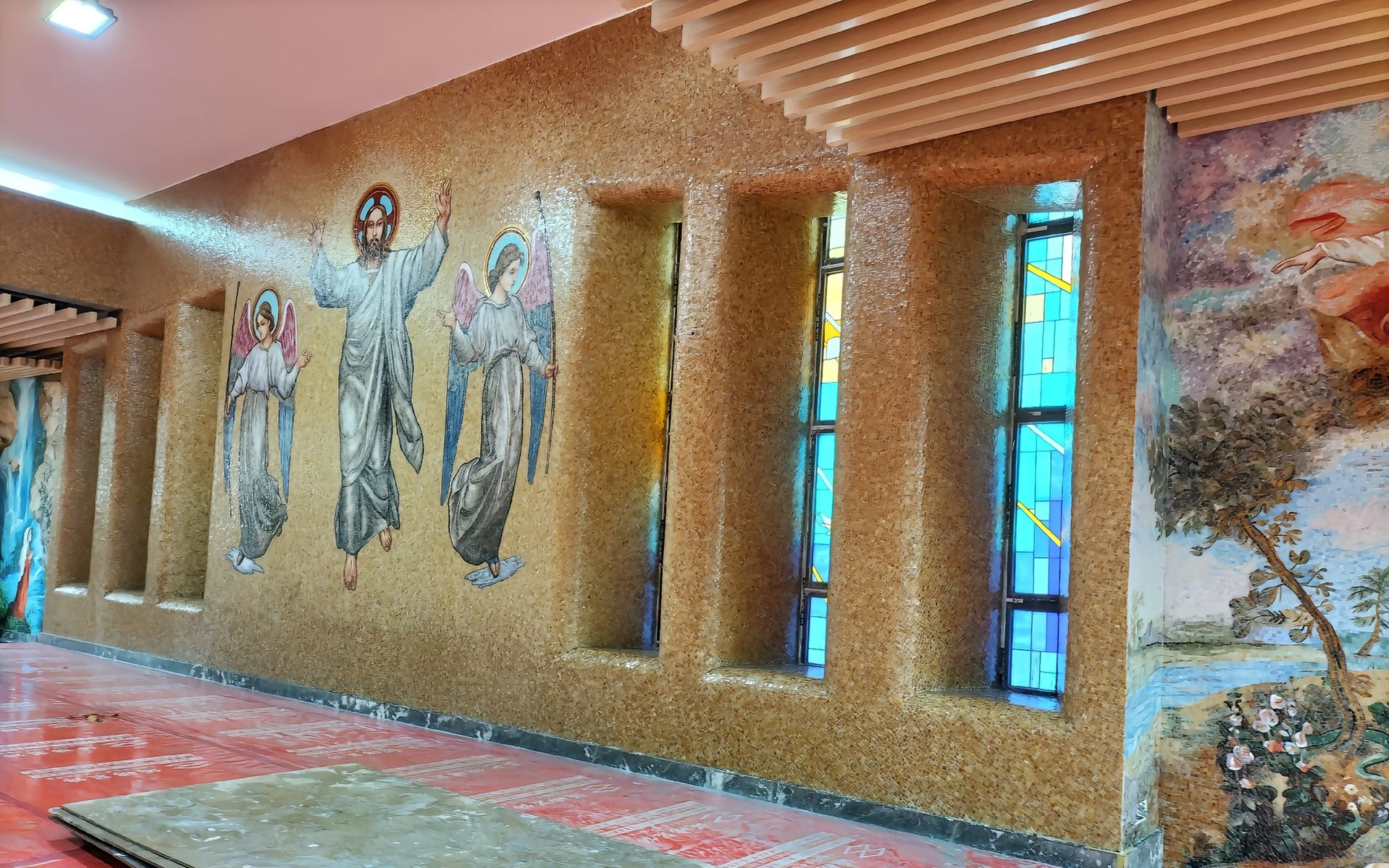
Taking the mosaics of Hagia Sophia as an example, the images of the Virgin Mary and Christ on the dome show the majesty and mercy of divinity with the golden background and delicate character depiction. The colors remain bright after thousands of years, interpreting the pursuit of eternity and holiness in Byzantine mosaics.
(II) Medieval Western Churches
For example, in the churches in the Ravenna area of Italy, the mosaic “Emperor Justinian and Empress Theodora in San Vitale” records the integration scene of historical figures and religious ceremonies through symmetrical composition and distinct colors, which is an artistic witness to the interweaving of religion and secular power.
V. Contemporary Value and Inheritance
(I) Artistic Aesthetic Value
Church mosaics break through the limitation of time. Their color application and composition skills provide inspiration for contemporary artists, influence the creation in fields such as painting and decorative art, and become an immortal aesthetic paradigm in the history of art.
(II) Mission of Cultural Inheritance
As a living fossil of religious culture, it carries national history and faith memory. Through restoration and exhibition, it continues to tell religious stories and convey cultural values to the public, allowing ancient art to radiate new vitality in contemporary society.
Church mosaics, with stones and glass as languages, paint a long scroll of faith. In the architectural space, they eternally tell the integration of the sacred, art, and history, waiting for the world to stop and listen, and feel the spiritual baptism across time and space.
Content Statement: The content of the article is created by integrating and referring to online knowledge. If there are inappropriate expressions or areas needing adjustment, please inform us, and we will handle and optimize it in a timely manner.


